


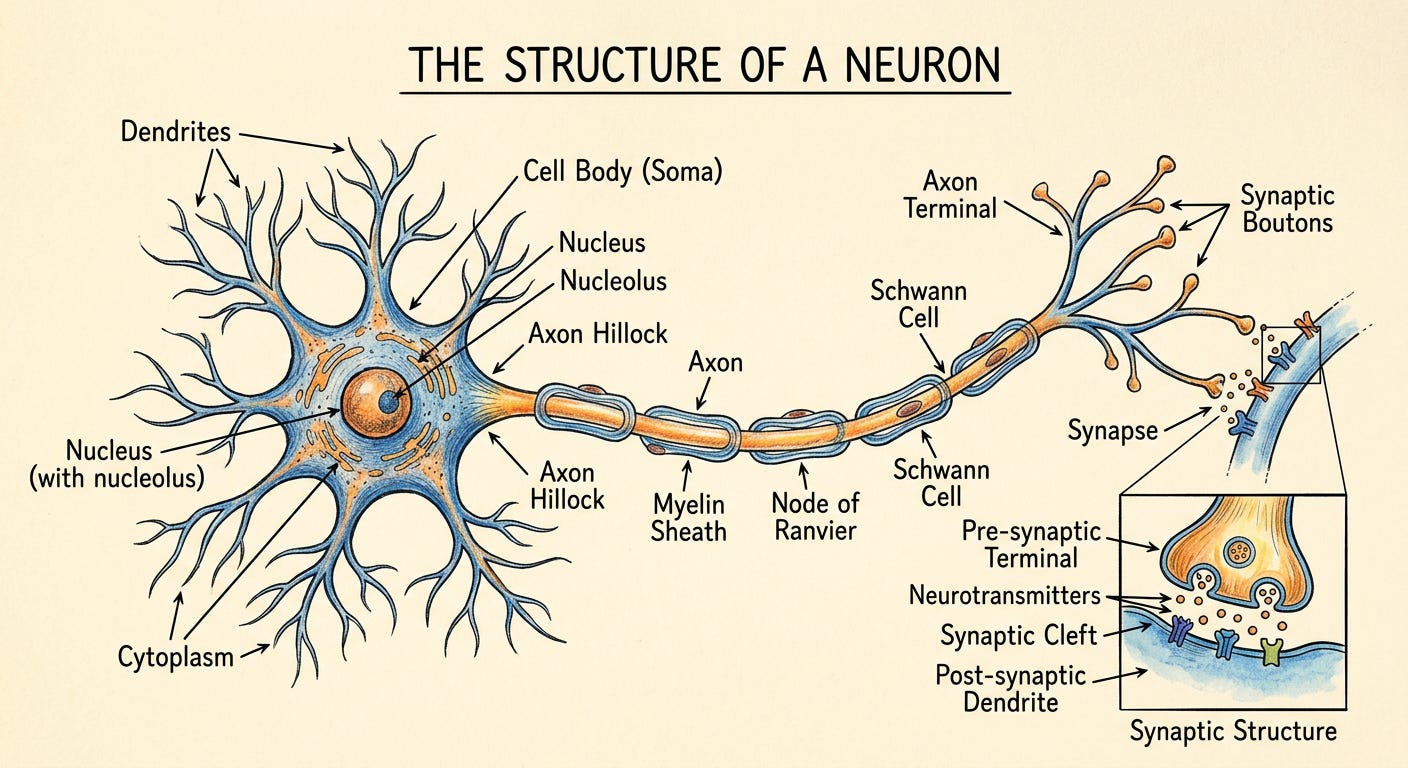
Figure 1: The Neuron
A neuron is a type of cell that is predominate in our central nervous system or CNS. This cell is mostly found in our brains. This is the smallest living unit of life in other words. Neurons work together to form a plastic network in our brains and spinal cords. These cells “fire” action potentials and are able to communicate very well with other neurons as well as several other cell types.
As you can see from the figure 1, the basic components of a neuron are the cell body, which is where most of the organelles, or tiny organs, inhabit, the axon, which is the long part of the neuron and is useful in propagating the action potential wave, as well as getting information across from the cell soma (or cell body) to the axon terminal, where it can then “release” this information onto the next neuron. The information is received by the dendrites of the cell, which are the tiny projections that are able to interpret the chemical neurotransmitters which bind to tiny receptors on the dendrites.
This is all the most basic information regarding neurons.